

Where did the new concept of productive discussion come from?
The term “nonviolent communication” is often encountered on the Internet these days. It is a way of describing rules for new users of a community, as well as a method to avoid unproductive discussions that quickly turn into exchanges of insults.
Since ancient times, people have respected the ability to conduct discussions in a calm and cultured manner, but the current concept of nonviolent communication was formulated as early as the 1960s by American psychologist Marshall Rosenberg. Since childhood, he was surprised by how aggressively and sometimes even violently things were handled in Detroit. The boy’s main dream was to create a universal model of communication in which violence and arguments would be minimized. Rosenberg desperately believed that people are by nature very empathetic creatures — the difficulty is that they don’t understand how to communicate without hurting others. You would assume that people are to blame for not knowing how to express themselves properly, but there’s more to it than that. Pay attention to language in general: there are many traces of the past in most of the words and language constructions we use. In distant history, sexism and racism against children or women was considered the norm. Unfortunately, language has not changed radically since then.
What is nonviolent communication?
Nonviolent communication is a method of conveying information in a clear way to the interlocutor, which allows you to get things done. The approach to this type of communication is described in detail by Marshall Rosenberg in his book “Nonviolent Communication: a Language of Life”.
Our needs are closely related to our emotions. We are happy when our needs are met, otherwise, we are frustrated. Rosenberg points out the need to understand people’s desires and give them empathy.
Instead of: “Normal people don’t make noise this late!”
Komunikacja bez przemocy: “Jest pierwsza w nocy i słyszę muzykę dochodzącą z waszego mieszkania. Złości mnie to, że nie mogę spać z tego powodu. Muszę się wyspać przed ciężkim dniem w pracy. Proszę trochę przyciszyć muzykę”.
The principle of nonviolent communication implies universality. Giving examples of its application, Rosenberg mentions in the book resolving situations with children, friends and even criminals. In each case, NVC finds common ground with the interlocutor without passive aggression.

How to apply nonviolent communication techniques in everyday life?
The basic components of nonviolent communication are:
1. Obserwacja faktów
Pierwszy krok opiera się na obserwacji faktów. Spróbuj wyjaśnić osobie, z którą rozmawiasz, co się stało i jak dokładnie to widzisz. Wspominaj o faktach bez ocen lub osądów. W przeciwnym razie człowiek usłyszy tylko słowa krytyki i podświadomie uniemożliwi sobie odbiór informacji. Zasłona niezrozumienia może zawisnąć nad komunikacją. Nie należy niczego przypuszczać za drugą osobę. Na przykład: “Nie odbierasz telefonu, bo jesteś nieodpowiedzialny!”
This does not mean that we should always be objective and completely abandon judgment. Marshall prompts us to make judgments based on our own observations. Imagine this or that situation from the outside, as if you were not participating in it. Pay attention to the objective details and facts you see.
Z oceną: “Michał jest złym pracownikiem”.
Bez oceny: “Michał trzykrotnie w ciągu ostatniego kwartału nie pojawił się w pracy i mimo moich próśb nie wyjaśnił dlaczego.”
Z oceną: “Bezczelnie się zachowujesz”.
Bez oceny: “Słyszałam, że dziś odpowiedziałeś do koleżanki podniesionym głosem, mimo iż ona mówiła do Ciebie spokojnie.”
2. Emotions
Next, you need to identify the emotion you are feeling. When communicating, people constantly convey emotions, but they usually do so nonverbally — through facial expressions, gestures and intonation. If we prefer a verbal form of communication, we can communicate more clearly and distinctly. By showing fear through facial expressions, you risk being misunderstood, and the other person may not appreciate the seriousness of the situation. After saying “I’m afraid,” the person you are talking to is sure to understand you.
Many people find it very difficult to express feelings verbally, especially those who do not know how to listen to themselves. Often feelings are confused with judgment or interpretation. Develop your vocabulary to clearly describe different emotions.
Insensitivity: “I feel that you don’t love me.”
Uczucie: “Smutno mi, czuję się nieważna dla Ciebie”.
Insensitivity: “I feel that I may not be able to cope in my new position.”
Feeling: “I am afraid of the level of responsibility in my new position.”
3. Need
An equally important element of NVC is the ability to express a need without judgment or giving one’s opinion. The essence of the need is to explain what the feelings come from and why this request matters to you. If this factor is neglected, the person may misperceive your words — as criticism. In such situations, people have defensive reactions. For example, if your wife says: “You work late into the night every day. You want to spend more time at work, not with me!”, it means that her need for romantic intimacy is unmet, at which time the man will hear criticism. The answer may come through passive aggression: “I work overtime to provide us with a comfortable life. You are ungrateful!” Every display of aggression hides the need for recognition.
Agresja: “Jak tak dalej pójdzie, to Cię wywalę z pracy”
Potrzeba: “Potrzebuję wiedzieć, że mogę liczyć na wszystkie osoby w moim zespole i mieć pewność, że jeśli pojawi się problem, to będziemy go wspólnie rozwiązywać.”
Agresja: “Mam dość tej sytuacji!”.
Potrzeba: “Potrzebuję odpocząć i zastanowić się jakie rozwiązanie będzie mi służyło”
4. Request
Ostatnim elementem komunikacji bez przemocy jest prośba — czyli to, co chcesz osiągnąć od innych, aby polepszyć swoje życie. Prośby należy formułować w sposób zrozumiały. Na przykład zamiast “zobaczymy się kiedyś”, podaj dokładną datę i godzinę, “spotkajmy się w poniedziałek o 18.00, ok?”.
Often people do things we may not like, not out of spite or hatred. They think they are doing the right thing. Clearly wording the request imposes a specific agenda on the person we are talking to. Rosenberg advises using more positive language and avoiding ambiguous descriptions.
Gdy człowiek czuje, że za nieposłuszeństwo zostanie ukarany, prośba będzie odebrana jako nakaz. W takiej sytuacji osoba ta może nawet odpowiedzieć agresją. Główną zasadą KBP nie jest osiąganie celów we wszelki sposób, ale budowanie relacji na zasadzie szczerości i empatii. Taki wynik w pełni zadowoli obie strony komunikacji.
Criticism: “Daughter, it’s time to grow up!”
Prośba: “Córko, bądź bardziej odpowiedzialna w kwestii zadań domowych, czy mogę Ciebie o to prosić?.”
Criticism: “Don’t let me down like this again.”
Prośba: “Czy możesz przychodzić na spotkania 5-10 minut przed ich rozpoczęciem?”.
Jak to wdrożyć w życie?
Przejście na komunikację bez przemocy wymaga praktyki. Miej cierpliwość i zanim je wyrazisz to spisz lub przeanalizuj w głowie dla siebie każdy z wymienionych wyżej kroków, np. “Ale mam zły humor od rana! Ale dlaczego? Aha, Konrad przywitał się ze wszystkimi oprócz mnie (fakt). Z tego powodu zrobiło mi się smutno (uczucie). Mam potrzebę dowiedzieć się czy zrobił to specjalnie czy po prostu mnie nie widział? (potrzeba informacji). O co mogę go poprosić, aby poczuć się lepiej? Chyba pomoże mi jak z nim pogadam (prośba do siebie samej, rozwiązanie).”
Staraj się też zrozumieć potrzeby innych i empatycznie reagować, gdy jest to możliwe. Ćwicz w codziennych sytuacjach, np. jeśli mężczyzna stojący w kolejce do lekarza mówi: “Ile to już czasu? Dlaczego to tak długo trwa!?”, okaż empatię i powiedz np. “Widzę, że jest Pan zły (uczucie), bo potrzebuje Pan się już spotkać z lekarzem (potrzeba), czy tak?”. Zobaczysz jak ludzie wokół Ciebie poczują się zrozumieni, a Ty nabierzesz pewności w komunikacji!
Dzięki codziennemu ćwiczeniu umiejętności obserwacji, nazywania uczuć i potrzeb oraz rozwiązań czy próśb będziesz mógł/mogła coraz skuteczniej stosować formułę Rosenberga w komunikacji w życiu prywatnym i zawodowym, co przeniesie Ciebie na wyższy poziom budowania relacji z ludźmi wokół Ciebie!
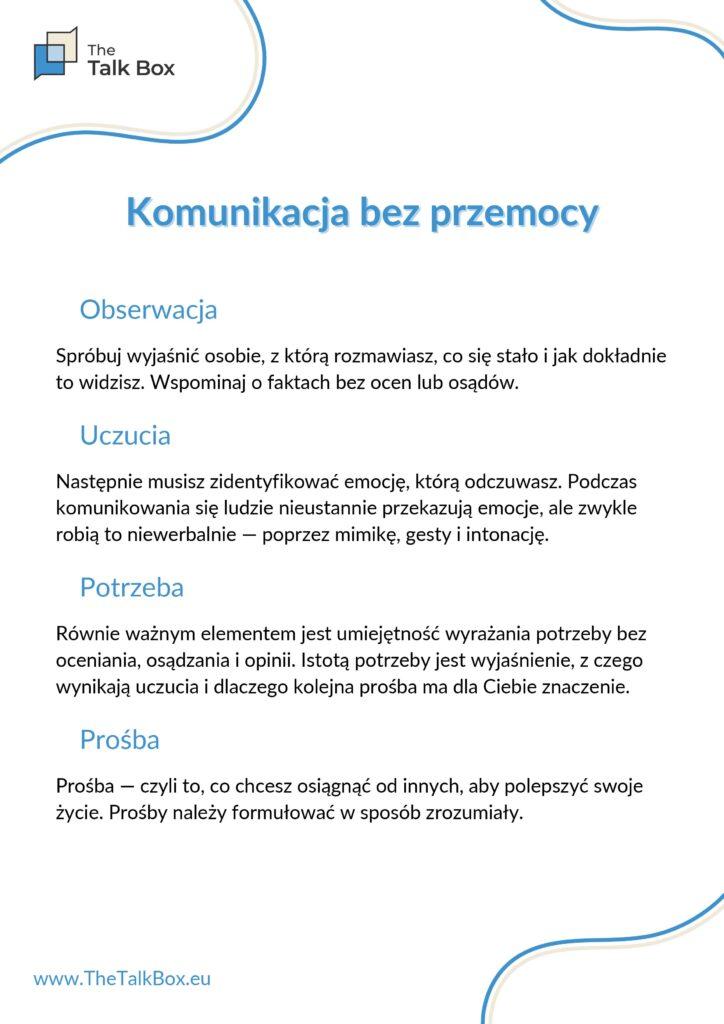
Here is a summary version of the 4 Steps to Nonviolent Communication which you can download below.
Recommended literature:
- https://streskiler.pl/porozumienie-bez-przemocy-czym-jest-i-jak-stosowac/ (Porozumienie Bez Przemocy – czym jest i jak stosować?) (Nonviolent Communication – what is it and how to use it?), viewed: 16 stycznia 2023
- Marshall B. Rosenberg – “Rozwiązywanie konfliktów poprzez porozumienie bez przemocy” (Nonviolent Communication: a Language of Life), wyd. Czarna Owca, Warszawa 2016, tłum. Barbara Wyczesany
- Marshall B. Rosenberg – “Porozumienie bez przemocy. O języku serca” (Nonviolent Communication: a Language of Compassion), wyd. Czarna Owca, Warszawa 2009, wydanie 2 rozszerzone
- Marshall B. Rosenberg – “Edukacja wzbogacająca życie” (Life-Enriching Education), wyd. Jacek Santorski & Co, Warszawa 2006, tłum. Anna Mills
Autor: Lev Ruts, Manuela Pliżga