
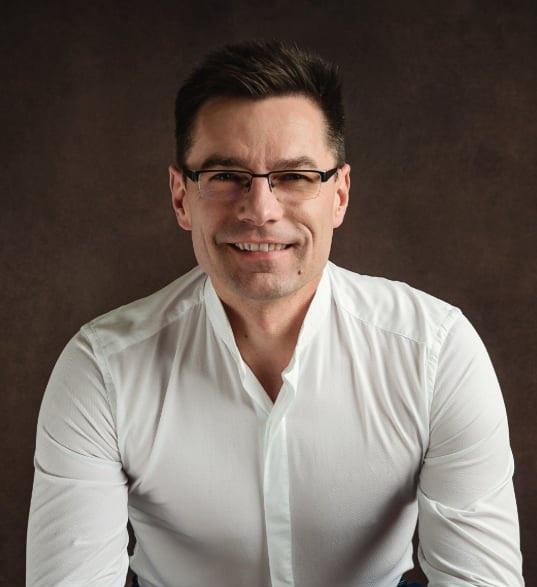
Recently, we had the pleasure of organizing another online meeting in cooperation with High School No. XV named after Major Piotr Wysocki in Wrocław. This time, the guest speaker was Radek Stano, who shared his experiences related to personal development, decision-making, and dealing with mistakes.
The conversation took the form of an open dialogue, during which all participants shared their experiences, impressions, and reflections. The following topics were discussed during the meeting:
- Youth, the need for acceptance, and relationships
- Mistakes as a part of growth
- The cult of idealism in the media
- Routine, change, and happiness
Youth, the Need for Acceptance, and Relationships
The first topics of discussion were youth and questions about the future. At some point, each of us wonders who we will become and how our lives will unfold. As Radek emphasized, it is natural during this period to seek inspiration from other people’s stories. However, it is important to maintain an independent identity and strive to follow one’s own path.
While discussing youth, we collectively observed that at a young age we are often highly sensitive to the opinions of others and have a strong need for acceptance within a group. Reflecting on his teenage years, Radek admitted that despite having a great deal of self-confidence and natural leadership qualities, belonging to a group and being accepted by those around him was very important. His desire to prove his worth was not only driven by personal ambition but also by a need to show others what he was capable of. As we grow older, this perspective begins to change. We become less focused on gaining acceptance at all costs and more conscious in choosing the people we surround ourselves with.
During the conversation, we also reflected on relationships with others. It is worth paying attention to how we feel in the presence of specific people-whether spending time with them gives us energy or drains it. This is often a good indicator of which relationships may be worth limiting and which should be developed with people who support and motivate us.
Mistakes as a Part of Growth
One of the most important themes discussed during the meeting was the topic of mistakes. Youth is marked by constantly making them; however, young people are often highly critical of themselves and fear the consequences. Mistakes are frequently treated as something that affects self-worth and self-esteem. As Radek shared, when he was younger, he was very afraid of making mistakes and being criticized by others. Over time, however, he realized that a mistake does not define a person but rather provides an opportunity for reflection and behavioral change. It is also worth remembering that the definition of a mistake is highly subjective. What may seem like a serious problem to one person may be only a minor setback to someone else.
Radek also shared a story from his youth. At the age of fifteen, he decided to learn how to play the guitar. He enrolled in a music club where many younger students already had much more experience. After three months of practice, he was scheduled to perform at a school talent show. When his turn came and he stood in front of the audience, everything suddenly slipped his mind. After two brief attempts, he managed to continue and play until the end. At that moment, it felt like a huge failure. Only later, when he looked back on the situation with greater perspective, did he realize that nothing truly serious had happened. This story illustrates how our perception of mistakes changes as we gain experience. Often, only with time do we recognize that situations that once seemed overwhelming were not as significant as they appeared. It is also important to filter criticism and consider whether the person judging us actually has the qualifications or credibility to do so.
The Cult of Idealism in the Media
One of the major challenges facing modern society is the widespread obsession with the idea of a perfect life. Social media creates an unrealistic image of success. Platforms such as Instagram show only a fragment of reality, while the difficulties and sacrifices behind success often remain hidden. When we see someone driving an expensive car, we are presented with a potentially misleading image of happiness. In reality, that person may not feel fulfilled at all and may be working from morning until night just to maintain their lifestyle.
Today’s media landscape places enormous pressure on young people to constantly achieve, stand out, and be perfect. Defining success through the lens of others often leads to frustration and a persistent feeling of inadequacy. Radek pointed out that instead of comparing ourselves to others, we should compare ourselves to who we were in the past. This allows us to recognize our own progress and appreciate the changes we have managed to make.
Sometimes success can be found in a small decision, such as going to a workout session or refusing to participate in something that goes against our values. This perspective helps us appreciate our own efforts and achievements. Real progress consists of small steps—sometimes we need to take one step back in order to move two steps forward later. The path to success does not lead through perfection. It is a continuous process that naturally involves making mistakes.
Routine, Change, and Happiness
Breaking free from routine and finding the courage to take action is one of the greatest challenges facing today’s youth. From an early age, we are taught to follow school routines, which later carry over into other areas of life. Daily patterns often cause us to stop trying new things, settle for our current circumstances, and limit our personal growth.
Social media only reinforces this trend. Endless scrolling has become a “disease” of the 21st century, affecting young people in particular. During the meeting, students noted that setting time limits on social media use can be a valuable first step toward positive change. Another effective way of stepping outside one’s comfort zone is physical activity. Regular exercise helps organize thoughts, restore balance, and approach everyday challenges with greater perspective.
Change often resembles a closed door—we do not know what lies on the other side until we open it. It is not a lack of opportunities that prevents us from taking action but rather the fear of making the first decision. As Radek emphasized, fear and uncertainty are natural parts of the process. What matters is not allowing them to stop us from moving forward. The search for fulfillment requires experimentation and the willingness to take on new challenges, while change itself is the only constant element of life.
The final, yet perhaps most important, topic of the meeting was happiness. There is no single, objective definition of happiness. Radek observed that it is worth seeking happiness primarily within ourselves. Appreciating ordinary moments, opportunities for growth, relationships with other people, and our own health can become the greatest sources of satisfaction. Each of us ultimately decides what success and happiness mean in our own lives.
The meeting with Radek Stano was an excellent opportunity to reflect on our personal journeys, decision-making processes, and perceptions of success and failure. We would like to thank Radek for sharing his experiences and engaging in such an inspiring conversation, as well as the students for their active participation and openness to discussion. We hope that the topics explored during the meeting will inspire further reflection and encourage everyone to courageously pursue their own path.
Author: Jakub Turczyński, SWPS University Wrocław student, Journalism and Social Communication
This article was created as part of an internship at The Talk Box.