Recently, we organized an exceptionally inspiring online meeting that connected students from the Major Piotr Wysocki General Secondary School No. XV in Wrocław with the international world of art. How art can become a conscious career choice and what challenges contemporary artists face were discussed by Polish-born artist Naomi Pomorska, who currently lives in Abu Dhabi.
During the meeting, held in an open and realistic atmosphere, the following topics were discussed:
- Who is Naomi Pomorska?
- Who can become an artist?
- The everyday life of an artist
- How to earn money from your work
- The importance of relationships and contacts
- Freedom without the guarantee of stability
Who is Naomi Pomorska?
Naomi comes from an artistic family, and a key role in shaping her artistic path was played by her grandfather, in whose studio she gained her first experience in painting. After graduating from an art high school, she began studying at the Academy of Fine Arts in Łódź. However, after completing her studies and facing the challenging realities of the art market, she temporarily stepped away from artistic practice to work as a graphic designer.
Over time, driven by an inner need to create, she decided to return to art and fully dedicate herself to her artistic work. Today, she lives and works in Abu Dhabi, where she focuses on painting, visual art, and performance art. Naomi’s work explores the relationships between the body and its surroundings. She is the Grand Prix laureate of the Hommage à Kobro competition, a scholarship holder of the ARTERIE Foundation, and a participant in numerous exhibitions in Poland and internationally.
Who can become an artist?
Naomi’s story became the starting point for a broader discussion about who can actually pursue creative work. According to the artist, anyone can choose this path, regardless of age. It is not limited to people who have known from the very beginning that art would be their main professional path. Many people discover their artistic passion at different stages of life. Artistic development paths vary greatly and do not always lead to a professional career in art—for some creators, art remains an important hobby.
The everyday life of an artist
During the meeting, we learned that the everyday life of an artist requires enormous dedication and full commitment to creative work. Artists do not perceive their activity merely as a job, but rather as a way of life. The creative process does not follow a fixed schedule, which is why artists often work when inspiration appears. The time needed to complete a project also varies. Some works take months to develop, while others may be completed in just a few hours, depending on the technique used or the level of complexity.
How to earn money from your work
Being an artist involves a much broader range of responsibilities than simply creating artworks. One of the important topics discussed during the meeting was the preparation of a portfolio, which is a fundamental tool for every artist. A portfolio allows artists to present their style, technique, and the direction of their artistic development to a wider audience.
From Naomi’s perspective, the visual appearance of the portfolio is less important than its content. A collection of works gathered in one place becomes the starting point for participating in competitions, exhibitions, and collaborations. For this reason, Naomi encourages artists to start building their portfolio as early as possible in their creative journey.
A different function is served by the CV, which acts more as an archival document, organizing information about a creator’s past activities and achievements. Preparing an artwork itself is only half of an artist’s success. Equally important is the ability to talk about one’s work. This does not mean aggressive self-promotion, but rather presenting one’s art by giving it a symbolic context and explaining its purpose and message.
The importance of relationships and contacts
Another topic discussed during the meeting was networking, which is often essential for success in the art world. Contacts can be built from an early stage by participating in volunteer work at festivals or art competitions. Showing initiative is key to demonstrating genuine commitment and gaining the first experiences within artistic circles.
Even without immediate benefits, volunteering can become a valuable element of an artist’s portfolio. The importance of relationships and the artistic community also appeared in the context of mentors. An external perspective on one’s work can accelerate development and help identify directions that might be overlooked from a subjective point of view.
The artist also highlighted the experience of working in an international artistic environment. Experiences gained outside Poland allow for a broader understanding of the art market and the opportunity to build connections in culturally diverse environments. In her opinion, the international market often offers more favorable conditions for contemporary artists to function professionally and sell their work. Openness to the world and willingness to move beyond the local context can significantly influence creative development.
Freedom without the guarantee of stability
An artistic path brings freedom, but it does not guarantee stability or a sense of security. It is a choice that requires courage and awareness of the challenges that come with it.
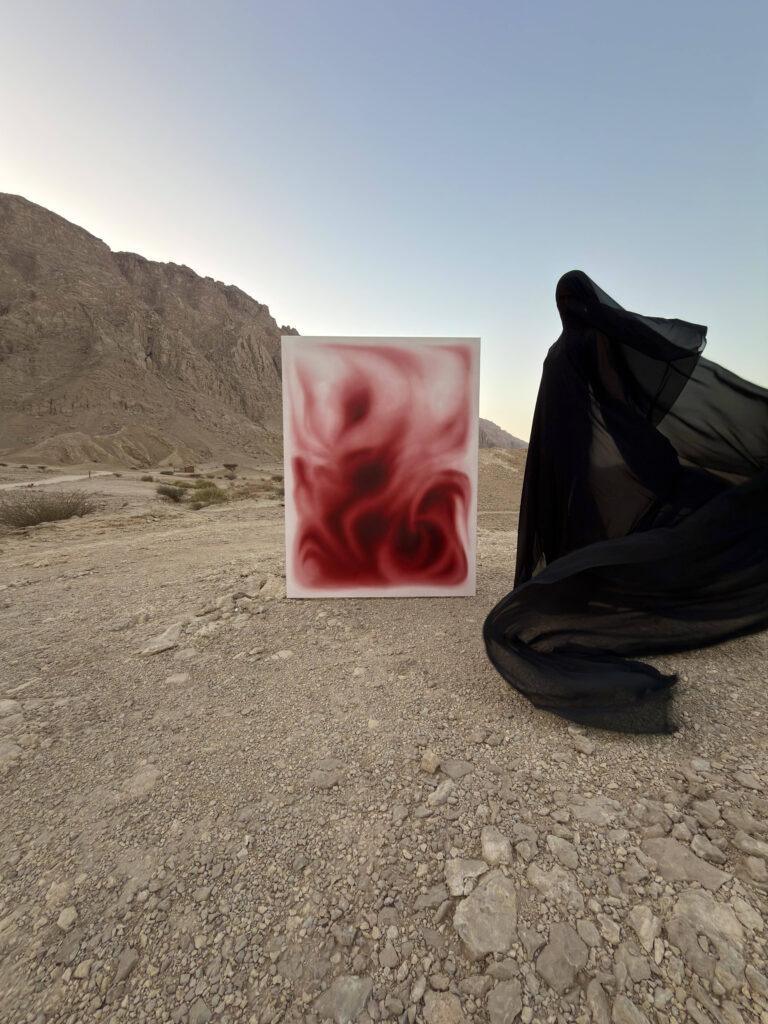
One of the most interesting threads mentioned during the conversation referred to one of Naomi’s latest works, which reflects the idea of continuous self-development as an endless process. The motif of sweeping the desert, although seemingly absurd at first glance, accurately illustrates the experiences that every artist faces.
We would like to thank Naomi for sharing her experience and for the inspiring conversation with the students. The meeting was more than just a dialogue—it encouraged deeper reflection on one’s own career path. The message that will stay with us for a long time, although seemingly simple, carries significant value: do what gives you a sense of meaning and do not postpone your personal development.
Author: Jakub Turczyński, student at SWPS University in Wrocław, Journalism and Social Communication
The text was created as part of an internship at The Talk Box.