
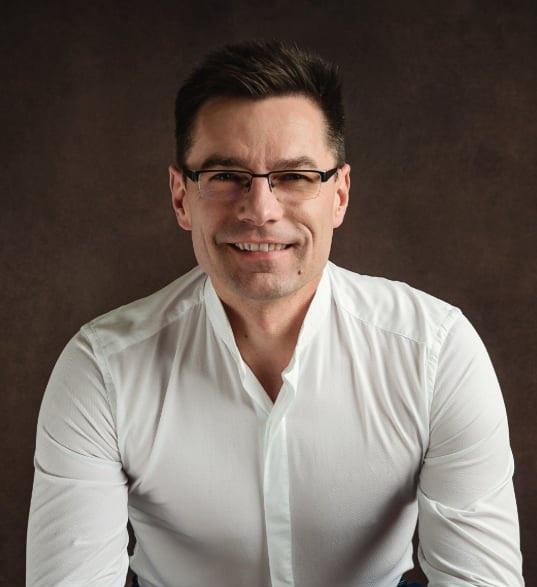
Manuela Pliżga asks, Radek Stano answers.
What is leadership really?
What is leadership really—beyond trendy slogans, presentations, and textbook theories? Is it a position, a title, and control, or rather the willingness to make decisions and take responsibility for their consequences?
Radek Stano has been active in the business world for over two decades. He started in sales, made mistakes, learned from them, managed teams, and today is responsible for companies and people. He does not separate leadership from everyday life—decisions are made not only at work but every day.
In an interview for The Talk Box, he talks about his career path, what schools and universities don’t teach, and leadership understood as an attitude, not a role.
What is your profession?
Simply put, I work with people and decisions. I am a manager and CEO, but these titles say little by themselves. On a daily basis, I connect people, ideas, and responsibility in such a way that plans turn into real actions.
My work involves making decisions that have consequences—for teams, clients, and companies. And this, much more than titles, is what leadership means to me.
What is your education?
I completed studies in management, then an MBA and a coaching school. I treat them as a solid foundation, but not as a ready-made answer for life.
I have learned the most in practice—when something went wrong, when I had to take responsibility and fix the consequences of my decisions.
What has your career path looked like?
I started my professional journey in 2001 in sales and in the investment and wholesale market. Between 2001-2006, I was associated with CERMAG, where I went through the full development path—from sales representative to director of branches in Świdnica and Legnica. I was responsible for achieving sales targets, negotiating with key clients, and managing sales structures. It was a period of intensive learning of responsibility and working for results.
In the following years, I developed in the sales structures of companies from the interior design, construction, and finishing industries, gradually taking on increasing responsibility for teams, processes, and financial results. Between 2015-2017, I served as Branch Director at CERMAG in Łódź, managing a multi-department structure including retail and wholesale sales as well as investment services. I was responsible for plan execution, recruitment, managerial coaching, and team competency development.
From 2020-2023, I served as Proxy at BROKS Group Ltd., responsible for representing the company, negotiating business deals, and building long-term business relationships. I also participated in organizing formal, sales, and process structures of the organization.
Since July 2023, I have been the CEO of BROKS Group Ltd., an owner-operated company specializing in the sale and installation of heating equipment. I am responsible for business development, sales processes, service standards, and full responsibility for the company’s financial results.
Simultaneously, since November 2023, I have been Branch Manager at VOX Capital Group—a nationwide capital group operating at the enterprise level. I oversee a local branch including sales and installation of interior solutions, developing B2B and B2C sales, and systematically improving operational profitability.
Throughout my career, I have managed teams of very different sizes—from small structures to large organizations—in sales, project, and service environments.
My career path was not a simple story of continuous growth and success. It also included a very difficult moment—the bankruptcy of a company I had previously built.
This experience taught me one of the most important lessons in life: not every failure means the end of the road, but each requires stopping and drawing conclusions. Without this, even the toughest experience changes little.
Today I know that experience alone can be misleading. There are people who make the same mistakes throughout their lives and gradually become very “experienced” in them. True value appears only when we can pause, understand the cause, and consciously change our way of acting.
Over time, I moved through successive roles—from salesperson, to manager, to someone responsible for entire organizations and their results. Today I can say I am on the right track—both in business and personal development, and in family relationships. I also increasingly focus on taking care of myself: physical health, mental balance, and mindfulness of my own needs.
I do not see it as a finish line, but as a continuous process of learning and course correction. Success does not happen once—it is built in daily choices, including the difficult ones.
I also increasingly see that achieving more does not mean the same thing for everyone. For some, it will be a company; for others, freedom, a sense of purpose, or a peaceful life. All of these paths are valid—as long as we walk them consciously.
Failure is therefore not the end of the story—it is often the moment when its wiser part begins.
What skills and traits distinguish you?
I know how to listen and ask questions. I like to use simple comparisons and stories because they help understand things that otherwise seem complicated.
I try to remain calm even when things go wrong. Instead of looking for someone to blame, I look for solutions. I treat mistakes as information—a signal that something needs correction.
I like to start things from scratch, test, and try different paths. At the same time, I try to be attentive to people and their emotions because without that no collaboration works.
What are you still learning—as a leader and as a person?
I am learning to better understand myself and others. Emotions—even difficult ones—carry information. Instead of ignoring them, it is worth observing them.
I am also learning patience and long-term thinking. Maturity is not only about acting quickly but also about the ability to pause and wait for the right moment.
What topics do you like to discuss?
I most often talk about decisions—why we do what we do.
Sometimes I ask people: “Is this your decision, or are you fulfilling someone else’s expectations?” Many people only realize later that they lived according to a script written by someone else.
It is not about rebellion; it is about awareness.
What are your Gallup strengths?
My dominant strengths include: Activator, Ideation, Woo, Visionary, Strategic, Achiever, Organizer, Self-Belief, Relator, and Significance.
They help me start new things, inspire others, and see beyond the “here and now.” At the same time, I have learned that strengths are not a guarantee of success.
Strengths are potential—decisions and daily actions determine whether that potential is well utilized.
What is most missing in the job market?
There is a lack of learning responsibility, intergenerational collaboration, and the courage to learn from mistakes. School provides knowledge but rarely teaches how to make decisions and deal with their consequences.
What has had the greatest impact on your thinking?
I believe in the great value of books, authorities, and stories of people who have gone before us. I read, listen, and learn because others’ experiences can shorten the path and protect against some mistakes.
At the same time, I know that stories alone change little if we do not allow ourselves to take the actions they inspire. You can read hundreds of books and change nothing in your life.
On the other hand, I have also learned that experience alone can be misleading. Some people make the same mistakes all their lives and become very experienced in them. Maturity begins when we can ask ourselves: why did this happen and what will I do differently next time?
Therefore, today I most believe in drawing conclusions and wisely navigating life—step by step, with mindfulness, responsibility, and readiness to correct the course.
How do you work with people?
I work best with people who want to learn—even if they don’t yet know how. I have seen many people who were initially not independent, but over time it turned out that they could do much more than they thought.
What is the main topic of your talks?
I talk about responsibility in practice—about decisions, their consequences, and working with people in real life, not theory. I talk about failures as an obvious part of the success story. Sometimes it seems like the end, but… it is often just the beginning of a great adventure.
What can participants expect?
Real stories, life examples, and questions that stay in mind. I do not teach how to be perfect. I talk about how to be aware, responsible, authentic, and brave.
Leadership is a daily practice of choices. And everyone—regardless of age—already makes them today.
Soon, Radek Stano will appear live during the online event The Talk Box, where he will talk about leadership, decisions, and responsibility—without theory, but with real-life business and life examples.