
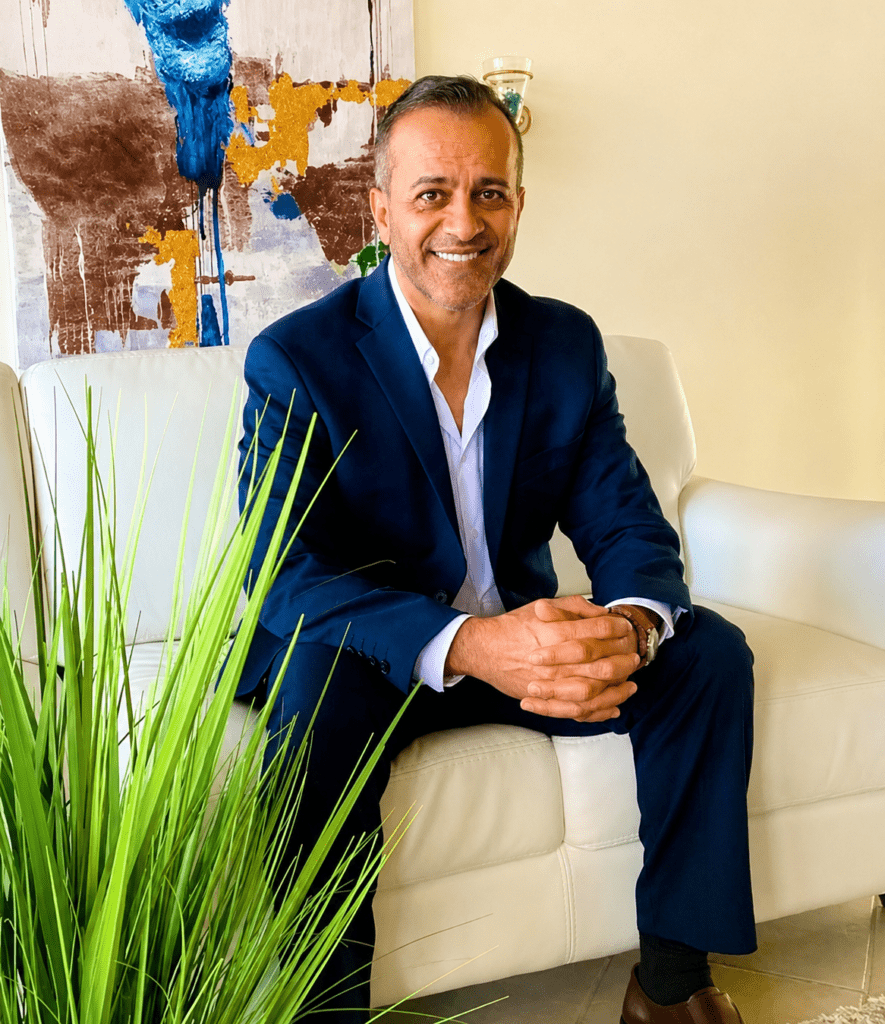
From war-torn Lebanon to a long and successful career in the United States – this is the journey of Ali Shami, the guest of our recent online meeting. Students at the XV General Secondary School named after Major Piotr Wysocki in Wrocław had the opportunity to hear his remarkable story, which was both inspiring and thought-provoking, encouraging them to reflect on their own choices and possibilities.
From War to Career – Journey Through a Life Full of Challenges
Ali’s childhood was far from easy. He grew up in Lebanon during the civil war, where even everyday activities could be dangerous. To illustrate this, he showed several photos from that time, including one of a sheet hung between buildings to protect people from snipers at a crosswalk. For most of us, crossing the street is something we take for granted, but for him, it was a real danger. This part of the meeting left a strong impression on the audience.
Despite these challenges, Ali maintained a positive outlook on life. Neither the war or financial difficulties stopped him from dreaming big. As a young boy, he often played soccer with his friends on a field near the airport. Whenever a plane was about to land, they would stop the game just to watch it. That’s when his fascination with aviation began.
While living in Beirut, he was a strong student. Determined to earn a scholarship to the U.S., he joined the crowds of applicants waiting outside the institution responsible for the program. At one point, a security guard became overwhelmed by the crowd and threatened to use his weapon if people didn’t move back. In the chaos, a shot was fired, and Ali was hit in the leg by a fragment. Even that didn’t stop him. He returned the very next day, and his persistence eventually paid off – he was awarded the scholarship.
He arrived in the United States with just $500 and no guarantee of success. Even at the airport, one of the officers he spoke with saw potential in him.
He went on to study in Alabama, where he worked on programming robots. After graduating, he began his career at Boeing – one of the world’s leading aerospace companies. He got the opportunity thanks to a friend from Lebanon, whom he had previously helped prepare for an English exam.
Over the next 30 years, Ali grew from an engineer to managing teams of dozens of people, eventually moving into consulting. Throughout his career, he has had the opportunity to represent Boeing internationally, including in countries such as South Korea, England, and Italy. Today, he owns a leadership consulting company and works at Boeing as a Senior Leadership Consultant.
Ali’s Top Tips
Based on his life experiences, Ali shared a few key lessons:
- “Why not me?” instead of “Why me?” – Even in the toughest situations, maintaining a positive mindset is essential. Challenges are a natural part of life, and accepting them allows you to focus on solutions and keep moving forward.
- Don’t give up! – Follow your path, no matter how slowly. If you just try and work hard – everything is possible. Don’t focus on the pace, but on the place you want to be in the future.
- Turn challenges into opportunities – Challenges don’t hold you back – they make you stronger. Just like in the gym, effort and discomfort are part of the process of growth.
- Set ambitious goal – Don’t settle for less than what you truly want. Keep pushing yourself forward. As Ali said, “Keep the flame of desire burning inside of you.”
- Give back and help others – Ali emphasized the importance of supporting others – what you give often comes back to you. He once helped a friend, who later returned the favor by helping him find a job. Today, he continues to give back through volunteer work with children in need.
- Take advantage of educational opportunities – If you have the chance to pursue education, take it – especially if it’s accessible or within your reach. As Ali’s father used to say: “If you have a gun in one hand and a pen in the other, which one will tire you out faster?”
Cultural Differences (Lebanon vs. the U.S.)
When Ali moved to the United States, he had to adjust to a reality very different from what he had seen in movies and TV shows. He emphasized how important it is to understand and respect the local culture, as people value this mindset and are more willing to offer support. During the meeting, he also shared his observations on the cultural differences between Lebanon and the United States.
Communication
Communication in the United States tends to be more direct, while in Lebanon it is often more indirect. Ali illustrated this with the example of borrowing a car. In Lebanon, a friend might agree to lend you a car even if they’re not entirely comfortable with it, often expressing this through subtle complaints. In the U.S., people are more likely to simply say no.
Conversation Style
Another difference lies in how conversations are conducted. In the United States, interrupting someone is generally seen as rude and disrespectful. In Lebanon, however, it is much more common and can even be seen as a sign of enthusiasm and engagement in the discussion.
Relationships
Social dynamics also differ significantly. Lebanese culture is more collective, with a strong emphasis on community and belonging. In contrast, American culture is more individualistic. This is also reflected in the concept of family – in the U.S., it typically refers to parents and children, while in Lebanon it often extends to grandparents, aunts, uncles, and cousins.
How Systems Function
There are also differences in how systems operate. In the United States, institutions tend to function efficiently – for example, emergency services respond quickly. In Lebanon, people often rely more on family and personal networks for support.
Meeting Ali was an experience that felt like a story straight out of a movie – full of challenges, determination, and perseverance. His story not only inspired the participants but also encouraged them to reflect on their own paths and possibilities. We are grateful for the time he shared with us and for his openness in telling his story. It is something that will undoubtedly stay with the participants for a long time.
Written by Jakub Turczyński, a student at SWPS University in Wrocław, majoring in Journalism and Social Communication